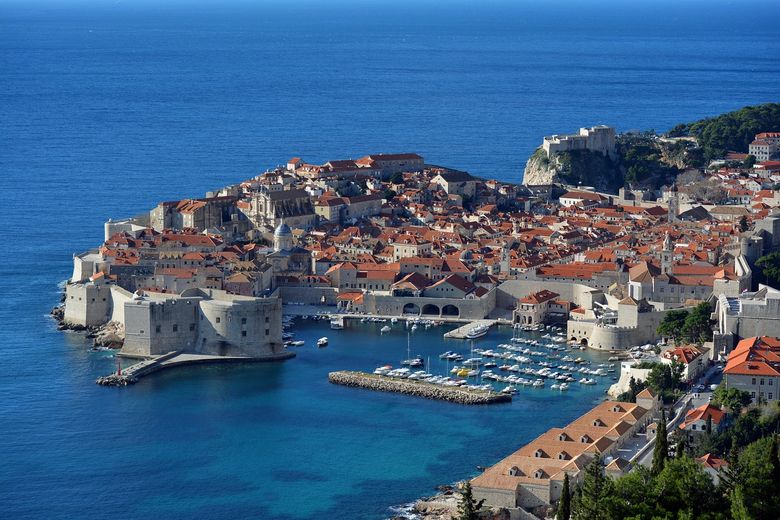
Few stretches of the Adriatic tell the story of Europe quite like Croatia’s Dalmatian coast. From the ancient streets of Split to the medieval walls of Dubrovnik, the region has been shaped by centuries of trade, migration, conquest and cultural exchange. Nowhere is that history more deliciously apparent than on the plate.
Dalmatian cuisine is unmistakably Croatian, built around the bounty of the Adriatic and the produce of the rugged hinterland. But look a little closer and you will find a distinctly Italian influence woven through it: handmade pasta, risotto, olive oil, tomatoes, garlic, herbs and an enduring love of simply prepared seafood.
The result is a cuisine that feels both Mediterranean and uniquely Dalmatian – rustic, fresh and deeply connected to the landscape.
A shared Adriatic table
The relationship between the eastern Adriatic and Italy goes back centuries. Venetian influence was particularly important, with the Republic of Venice controlling or influencing large parts of the Dalmatian coast for extended periods. Trade routes connected coastal cities with Venice and the wider Mediterranean, bringing not only goods but culinary ideas.
That history helps explain why certain foods feel familiar to an Italian traveller while retaining a distinctly Croatian character. Along the coast, seafood is rarely buried beneath heavy sauces or elaborate preparation. Instead, fish, shellfish and squid are typically allowed to speak for themselves, enhanced with olive oil, lemon, garlic, parsley and local herbs.
It is an approach shared across the Adriatic: take excellent ingredients, keep the cooking straightforward and let the quality of the produce do the work.
Handmade pasta with a Dalmatian accent
Perhaps nowhere is the Italian influence more obvious than in Dalmatia’s pasta traditions. One example is makaruni, a traditional pasta found in parts of the region. Handmade pasta has long been part of the culinary repertoire of coastal communities, and its presence reflects the close historical connections between Dalmatia and the Italian peninsula.
But Dalmatian pasta is not simply Italian pasta transplanted across the Adriatic. Local ingredients give it a character of its own. Pasta might be paired with seafood, tomato, garlic, herbs or slow-cooked meat, creating dishes that sit comfortably between Italian and Croatian culinary traditions.
The same is true of rižot, Dalmatian-style risotto. Black risotto, or crni rižot, is one of the coast’s signature dishes, coloured dramatically by cuttlefish ink and packed with the flavour of the Adriatic. It is recognisably part of the wider Mediterranean risotto tradition, yet its emphasis on cuttlefish and local seafood makes it quintessentially Dalmatian.
Olive oil: the common language of the Adriatic
If there is one ingredient that connects the culinary traditions of Italy and Dalmatia, it is olive oil. Olive cultivation has been part of life along the eastern Adriatic for thousands of years. In Dalmatia, olive trees thrive in the region’s dry, sunny climate, producing oils that are increasingly appreciated for their quality.
Rather than being treated merely as a cooking ingredient, extra virgin olive oil is often used as a finishing touch – drizzled over grilled fish, vegetables, bread or salads.
This is perhaps the simplest expression of the region’s culinary philosophy: excellent local ingredients require very little intervention.
From Split to Dubrovnik: a changing culinary landscape
As you travel south, the landscape changes, but the Mediterranean character of the cuisine remains. Along the coast and islands, seafood dominates. In smaller towns, traditional konobas offer dishes that have changed remarkably little over generations. Grilled sardines, octopus salad, mussels, prawns and locally caught fish showcase the extraordinary variety of the Adriatic.
Further south, around Dubrovnik and the Dubrovnik-Neretva region, the influence of neighbouring Mediterranean cultures becomes even more apparent. Citrus, figs, almonds, wine, olive oil and seafood all feature heavily.
One local speciality worth seeking out is brodet, a rustic fish stew made with several types of fish and typically served with polenta. Like many Adriatic dishes, its precise preparation varies from place to place, but its origins lie in the practical cooking traditions of coastal communities.
The Italian connection is particularly clear when brodet is compared with the fish stews found along Italy’s Adriatic coast. The dishes are not identical, but they reflect the same maritime culture and a
That is ultimately the beauty of Dalmatian cuisine. It is a record of the region’s history without feeling like a museum piece. Venetian merchants, Roman settlers, Croatian fishermen and generations of local cooks have all left their mark – and the result is a cuisine that belongs unmistakably to the Adriatic.
From the ancient heart of Split to the dramatic shores of Dubrovnik, the best way to understand Dalmatia may simply be to eat your way along the coast. Here, history is served on a plate, poured into a wine glass and carried on the sea breeze.